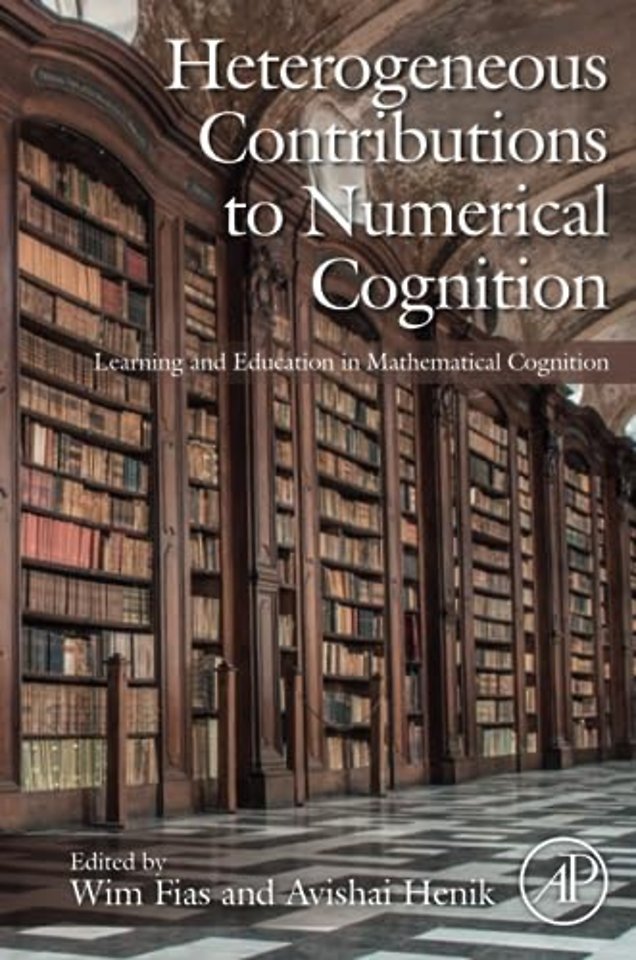
Heterogeneous Contributions to Numerical Cognition
Learning and Education in Mathematical Cognition
Gebonden Engels 2021 9780128174142Samenvatting
Arithmetic disability stems from deficits in neurodevelopment, with great individual differences in development or function of an individual at neuroanatomical, neuropsychological, behavioral, and interactional levels. Heterogeneous Contributions to Numerical Cognition: Learning and Education in Mathematical Cognition examines research in mathematical education methods and their neurodevelopmental basis, focusing on the underlying neurodevelopmental features that must be taken into account when teaching and learning mathematics. Cognitive domains and functions such as executive functions, memory, attention, and language contribute to numerical cognition and are essential for its proper development. These lines of research and thinking in neuroscience are discussed in this book to further the understanding of the neurodevelopmental and cognitive basis of more complex forms of mathematics – and how to best teach them. By unravelling the basic building blocks of numerical thinking and the developmental basis of human capacity for arithmetic, this book and the discussions within are important for the achievement of a comprehensive understanding of numerical cognition, its brain basis, development, breakdown in brain-injured individuals, and failures to master mathematical skills.
Specificaties
Lezersrecensies
Inhoudsopgave
Rubrieken
- advisering
- algemeen management
- coaching en trainen
- communicatie en media
- economie
- financieel management
- inkoop en logistiek
- internet en social media
- it-management / ict
- juridisch
- leiderschap
- marketing
- mens en maatschappij
- non-profit
- ondernemen
- organisatiekunde
- personal finance
- personeelsmanagement
- persoonlijke effectiviteit
- projectmanagement
- psychologie
- reclame en verkoop
- strategisch management
- verandermanagement
- werk en loopbaan