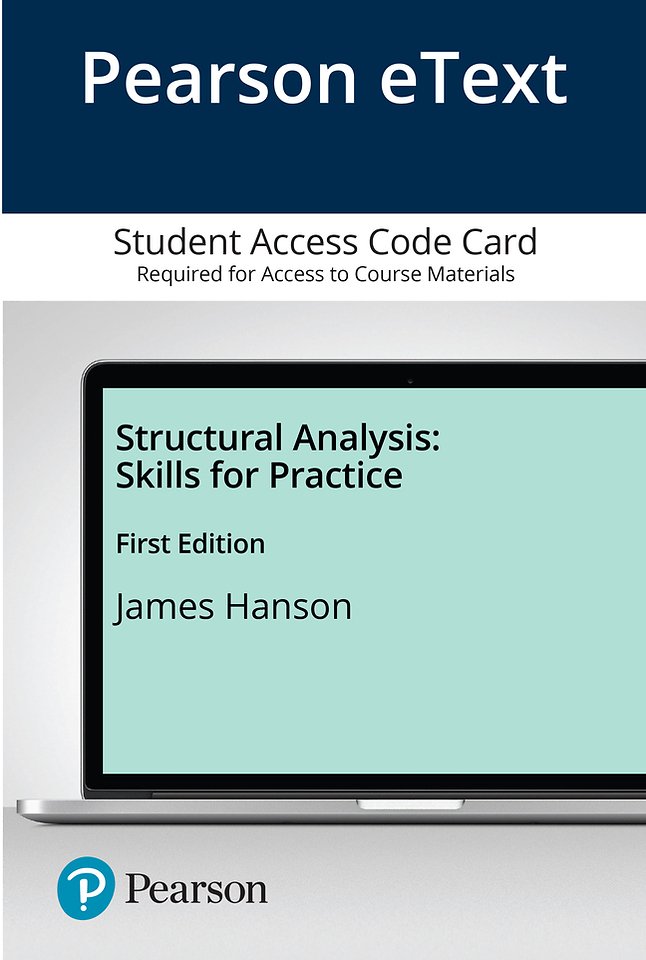
Structural Analysis

Skills for Practice

Onbekend Engels 2019 9780134877105
€ 54,94
Levertijd ongeveer 9 werkdagen
Gratis verzonden

Samenvatting

For courses in structural analysis.

Teach students to develop their intuition and the habit of evaluating their results

Structural Analysis: Skills for Practice encourages engineering students to develop their intuition and the habit of evaluating the reasonableness of structural analysis results. The author presents examples and homework problems that incorporate a consistent thought process structure (guess, calculate, and evaluate their results), helping students develop the metacognitive skill of thinking about their own thought process. The text presents content not seen in other structural analysis books that students need to know to pass their licensure exam, and frames ideas in the context of how they will apply it on the job. Drawing upon the evaluation skills gathered from a six-year project with experienced structural engineers, Hanson's Structural Analysis helps students learn skills to transition from novice to expert faster and become more competent in their careers.

Extend learning beyond the classroom
Pearson eText is an easy-to-use digital textbook that students can purchase on their own or you can assign for your course. It lets students read, highlight, and take notes all in one place. The mobile app lets students learn on the go, offline or online. Creating a course allows you to schedule readings, view reading analytics, and share your own notes with students, motivating them to keep reading, and keep learning. Learn more about Pearson eText.

Specificaties

ISBN13:9780134877105
Taal:Engels
Bindwijze:onbekend

Lezersrecensies

Wees de eerste die een lezersrecensie schrijft!

Inhoudsopgave

<div class="c-un-numbered-headers-and-contents-list__container"> <ol> <li><strong>Loads and Structure Idealization</strong> <ul> <li>1.1 Loads</li> <li>1.2 Load Combinations</li> <li>1.3 Structure Idealization</li> <li>1.4 Application of Gravity Loads</li> <li>1.5 Application of Lateral Loads</li> <li>1.6 Distribution of Lateral Loads by Flexible Diaphragm</li> </ul></li> <li><strong>Predicting Results</strong> <ul> <li>2.1 Qualitative Truss Analysis</li> <li>2.2 Principle of Superposition</li> <li>2.3 Principle of Superposition</li> <li>2.4 Approximating Loading Conditions</li> </ul></li> <li><strong>Cables and Arches</strong> <ul> <li>3.1 Cables with Point Loads</li> <li>3.2 Cables with Uniform Loads</li> <li>3.3 Arches</li> </ul></li> <li><strong>Internal Force Diagrams</strong> <ul> <li>4.1 Internal Forces by Integration</li> <li>4.2 Constructing Diagrams by Deduction</li> <li>4.3 Diagrams for Frames</li> </ul></li> <li><strong>Deformations</strong> <ul> <li>5.1 Double Integration Method</li> <li>5.2 Conjugate Beam Method</li> <li>5.3 Virtual Work Method</li> </ul></li> <li><strong>Influence Lines</strong> <ul> <li>6.1 Table-of-Points Method</li> <li>6.2 Müller-Breslau Method</li> <li>6.3 Using Influence Lines</li> </ul></li> <li><strong>Introduction to Computer Aided Analysis</strong> <ul> <li>7.1 Why Computer Results are Always Wrong</li> <li>7.2 Checking Fundamental Principles</li> <li>7.3 Checking Features of the Solution</li> </ul></li> <li><strong>Approximate Analysis of Indeterminate Trusses and Braced Frames</strong> <ul> <li>8.1 Indeterminate Trusses</li> <li>8.2 Braced Frames with Lateral Loads</li> <li>8.3 Braced Frames with Gravity Loads</li> </ul></li> <li><strong>Approximate Analysis of Rigid Frames</strong> <ul> <li>9.1 Gravity Load Method</li> <li>9.2 Portal Method for Lateral Loads</li> <li>9.3 Cantilever Method for Lateral Loads</li> <li>9.4 Combined Gravity and Lateral Loads</li> </ul></li> <li><strong>Approximate Lateral Displacements</strong> <ul> <li>10.1 Braced Frames — Story Drift Method</li> <li>10.2 Braced Frames — Virtual Work Method</li> <li>10.3 Rigid Frames — Stiff Beam Method</li> <li>10.4 Rigid Frames — Virtual Work Method</li> <li>10.5 Solid Walls — Single Story</li> <li>10.6 Solid Walls — Multistory</li> </ul></li> <li><strong>Diaphragms</strong> <ul> <li>11.1 Distribution of Lateral Loads by Rigid Diaphragm</li> <li>11.2 In Plane Shear: Collector Beams</li> <li>11.3 In Plane Moment: Diaphragm Chords</li> </ul></li> <li><strong>Force Method</strong> <ul> <li>12.1 One Degree Indeterminate Beams</li> <li>12.2 Multi-Degree Indeterminate Beams</li> <li>12.3 Indeterminate Trusses</li> </ul></li> <li><strong>Moment Distribution Method</strong> <ul> <li>13.1 Overview of Method</li> <li>13.2 Fixed End Moments and Distribution Factors</li> <li>13.3 Beams and Sidesway Inhibited Frames</li> <li>13.4 Sidesway Frames</li> </ul></li> <li><strong>Direct Stiffness Method for Trusses</strong> <ul> <li>14.1 Overview of Method</li> <li>14.2 Transformation and Element Stiffness Matrices</li> <li>14.3 Compiling the System of Equations</li> <li>14.4 Finding Deformations, Reactions and Internal Forces</li> <li>14.5 Additional Loadings</li> </ul></li> <li><strong>Direct Stiffness Method for Frames</strong> <ul> <li>15.1 Element Stiffness Matrix</li> <li>15.2 Transformation Matrix</li> <li>15.3 Global Stiffness Matrix</li> <li>15.4 Loads Between Nodes</li> <li>15.5 Direct Stiffness Method</li> <li>15.6 Internal Forces</li> </ul></li> </ol> </div>

Managementboek Top 100

€ 54,94
Levertijd ongeveer 9 werkdagen
Gratis verzonden

Rubrieken

    Personen

      Trefwoorden

        Structural Analysis