Alberto Bisin
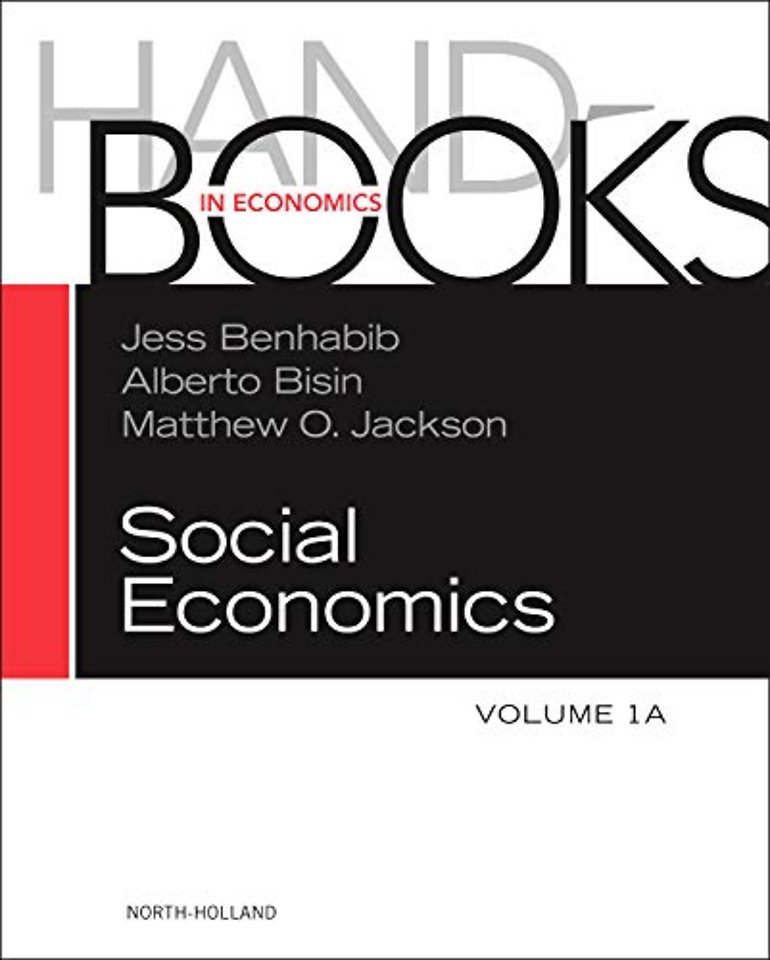
Handbook of Social Economics
Gebonden Engels 2010 9780444531872Levertijd ongeveer 9 werkdagen
Gratis verzonden
Samenvatting
How can economists define social preferences and interactions?
Culture, familial beliefs, religion, and other sources contain the origins of social preferences. Those preferences--the desire for social status, for instance, or the disinclination to receive financial support--often accompany predictable economic outcomes. Through the use of new economic data and tools, our contributors survey an array of social interactions and decisions that typify homo economicus. Their work brings order to the sometimes conflicting claims that countries, environments, beliefs, and other influences make on our economic decisions.
Specificaties
ISBN13:9780444531872
Taal:Engels
Bindwijze:Gebonden
Uitgever:Elsevier Science
Serie:Handbooks in Economics
Lezersrecensies
Wees de eerste die een lezersrecensie schrijft!
Inhoudsopgave
Social Preferences <ul> <li>Nature and Nurture Effects On Children's Outcomes (Bruce Sacerdote)</li> <li>Social Norms and Preferences (Andrew Postlewaite)</li> <li>Preferences for Status: Evidence and Economic Implications (Ori Heffetz and Robert H. Frank) </li> <li>Preferences for Redistribution (Alberto Alesina and Paola Giuliano)</li> <li>Theories of Statistical Discrimination and Affirmative Action (Hanmign Fang and Andrea Moro)</li> <li>Social Construction of Preferences: Advertising (Jess Benhabib and Alberto Bisin)</li> <li>The Evolutionary Foundations of Preferences (Arthur J. Robson and Larry Samuelson)</li> <li>Social Norms (Mary A. Burke and H. Peyton Young)</li> <li>The Economics of Cultural Transmission and Socialization (Alberto Bisin and Thierry Verdier)</li> <li>Civic Capital as the Missing Link (Luigi Guiso, Paola Sapienza, and Luigi Zingales)</li> <li>Does Culture Matter? (Raquel Fernández)</li></ul> <p> Social Actions</p> <ul> <li>An Overview of Social networks and Economic Applications (Matthew O. Jackson)</li> <li>Local Interactions (Onur Özgür)</li> <li>Diffusion, Strategic Interaction, and Social Structure (Matthew O. jackson and Leeat Yariv)</li> <li>Learning in Networks (Sanjeev Goyal) </li> <li>Formation of Networks and Coalitions (Francis Block and Bhaskar Dutta)</li> <li>Matching, Allocation, and Exchange of Discrete Resources (Tayfun Sönmez and M. Utku Ünver)</li></ul>
Rubrieken
- advisering
- algemeen management
- coaching en trainen
- communicatie en media
- economie
- financieel management
- inkoop en logistiek
- internet en social media
- it-management / ict
- juridisch
- leiderschap
- marketing
- mens en maatschappij
- non-profit
- ondernemen
- organisatiekunde
- personal finance
- personeelsmanagement
- persoonlijke effectiviteit
- projectmanagement
- psychologie
- reclame en verkoop
- strategisch management
- verandermanagement
- werk en loopbaan