
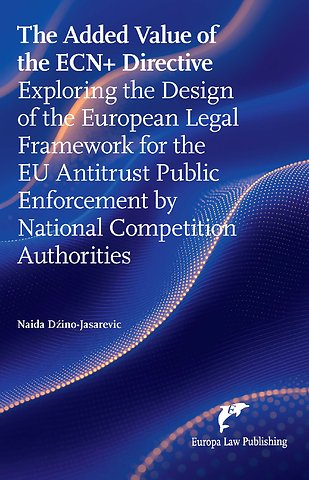

Her study examines the design of the European legal framework for the EU antitrust public enforcement by National Competition Authorities (NCAs).
Meer over Naida Dzino-Jasarevic
The Added Value of the ECN+ Directive
Exploring the Design of the European Legal Framework for the EU Antitrust Public Enforcement by National Competition Authorities
Paperback Nederlands 2026 1e druk 9789462513877Samenvatting
It evaluates whether the ECN+ Directive equips NCAs to act effectively, enabling them to reach the objectives of EU antitrust public enforcement, namely creating deterrence, clarifying the law and ensuring procedural fairness.
Effectiveness is evaluated across six indicators, namely: independence and resources, investigative
powers, decision-making powers, sanctioning powers, leniency and cooperation. Drawing on insights from Germany and the Netherlands, the study proposes concrete improvements to strengthen the EU enforcement framework.
Trefwoorden
Specificaties
Lezersrecensies
Inhoudsopgave
Preface vii
Acknowledgements xi
Table of contents xv
CHAPTER 1 Introduction
1. Introduction
2. Challenges to public enforcement under Regulation 1/2003
3. Research question and sub-questions
3.1. Choice of legal systems explored
3.2. Delineation
4. Broader context surrounding effectiveness
4.1. Multi-level governance
4.2. Implementation matters
4.3. Incorrect transposition
5. Structure
CHAPTER 2 Approach, concepts and methods
1. Introduction
2. Clarification of concepts
2.1. Effectiveness
2.1.1. Effectiveness in past research
2.1.2. Defining effectiveness
2.1.3. Objectives of EU antitrust public enforcement
3. Choosing the relevant indicators
3.1. Independence and resources
3.2. Investigation powers
3.3. Decision-making powers
3.4. Sanctioning
3.5. Leniency
3.6. Cooperation
3.7. Summing up
4. Conclusion
CHAPTER 3 EU antitrust public enforcement under Regulation 1/2003
1. Introduction
1.1. Purpose
1.2. Structure
2. Regulation 1/2003 and national autonomy
2.1. National institutional autonomy
2.2. National procedural autonomy
3. Reviewing Regulation 1/2003 in the light of the indicators
3.1. NCAs institutional design: independence and resources
3.2. Investigation powers
3.2.1. Regulation 1/2003: types of investigative powers
3.2.2. Investigations carried out by NCAs
3.3. Decision-making powers
3.3.1. Article 5 of Regulation 1/2003
3.3.2. Non-infringement decisions
3.4. Sanctioning
3.5. Leniency
3.6. Cooperation
3.6.1. Cooperation provisions in Regulation 1/2003
3.6.2. Role of the European Competition Network
4. Trust between the Commission and the NCAs?
5. Conclusion
CHAPTER 4 Directive 2019/1: towards an effective framework for NCAs?
1. Introduction
1.1. Purpose
1.2. Structure
2. How does Directive 2019/1 intend to complement Regulation 1/2003?
2.1. Process leading to the adoption of Directive 2019/1
2.2. Subsidiarity
2.3. What type of harmonisation? Proportionality
2.4. Objectives of the Directive and legal basis
2.5. The views of the Dutch and German authorities on adopting a Directive
3. Reviewing Directive 2019/1 in the light of the indicators
3.1. Institutional setup of NCAs
3.2. Investigation powers of the NCA
3.3. Decision-making powers of NCAs
3.4. Sanctioning
3.5. Leniency
3.6. Cooperation
4. Evaluation: remaining issues
5. Trust in the enforcement work of the NCAs?
6. Conclusion
CHAPTER 5 The ECN+ Directive and the EU antitrust public enforcement in Germany and the Netherlands
1. Introduction
1.1. Purpose
1.2. Structure
2. Domestic public enforcement of the EU antitrust rules
2.1. Choice of administrative model: Germany
2.2. Choice of administrative model: the Netherlands
3. Public enforcement of EU antitrust law in Germany
3.1. Institutional set-up
3.1.1. Operational independence
3.1.2. Organisational and financial independence
3.2. Investigation powers
3.3. Decision-making powers
3.3.1. Interim measures
3.3.2. Commitments
3.3.3. Negative decisions
3.4. Sanctions
3.5. Leniency
3.6. Cooperation
3.7. Résumé
4. Public enforcement of EU antitrust law in the Netherlands
4.1. Institutional set-up
4.1.1. Operational independence
4.1.2. Organisational and financial independence
4.2. Investigation powers
4.3. Decision-making powers
4.3.1. Interim measures
4.3.2. Commitments
4.3.3. Negative decisions
4.4. Sanctioning
4.5. Leniency
4.6. Cooperation
4.7. Résumé
5. Conclusion
CHAPTER 6 Synthesis
1. Introduction
2. Indicators
3. Directive 2019/1
3.1. Directive 2019/1 addresses many gaps signalled under Regulation 1/2003
3.2. Remaining gaps that Directive 2019/1 did not address
3.3. Some Directive provisions are too general and broadly formulated
3.4. Directive 2019/1 powers go further than powers under Regulation 1/2003
4. The implementation of Directive 2019/1 in Germany and the Netherlands
4.1. Independence and resources
4.2. Investigation powers
4.3. Decision-making powers
4.4. Sanctioning
4.5. Leniency
4.6. Cooperation
5. Recommendations: how can Directive 2019/1 be further improved?
6. Conclusion
CHAPTER 7 Conclusion
1. Introduction
2. Directive 2019/1 and the effectiveness of NCAs
3. Remaining observations
3.1. The reinforcement of a multi-layered enforcement system
3.2. Spill-over to other competition law public enforcers
4. Final observations
Summary in Dutch
Bibliography
Anderen die dit boek kochten, kochten ook
Rubrieken
- advisering
- algemeen management
- coaching en trainen
- communicatie en media
- economie
- financieel management
- inkoop en logistiek
- internet en social media
- it-management / ict
- juridisch
- leiderschap
- marketing
- mens en maatschappij
- non-profit
- ondernemen
- organisatiekunde
- personal finance
- personeelsmanagement
- persoonlijke effectiviteit
- projectmanagement
- psychologie
- reclame en verkoop
- strategisch management
- verandermanagement
- werk en loopbaan