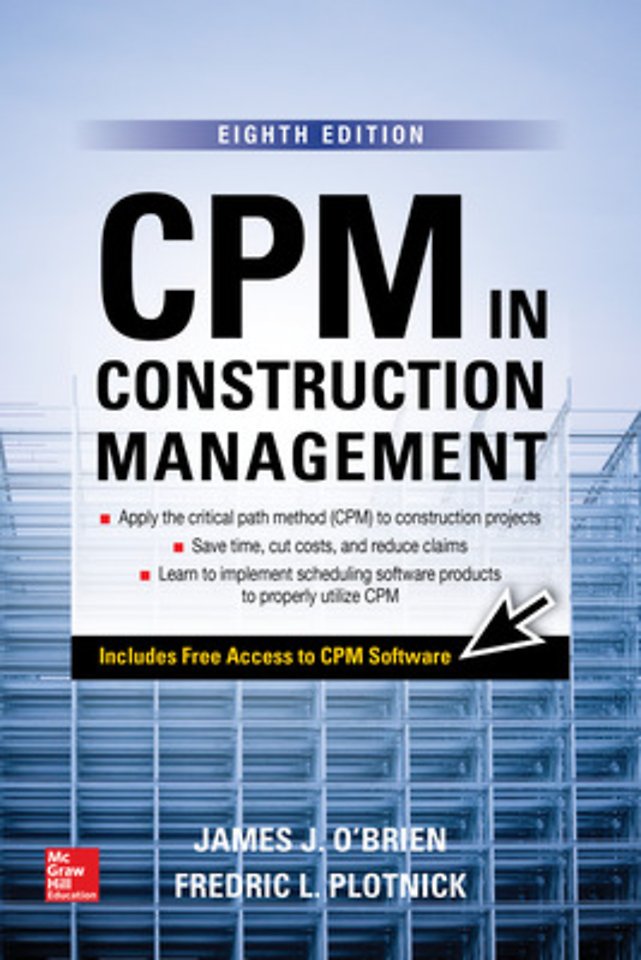
CPM in Construction Management, Eighth Edition
Paperback Engels 2015 8e druk 9781259587276Samenvatting
Publisher's Note: Products purchased from Third Party sellers are not guaranteed by the publisher for quality, authenticity, or access to any online entitlements included with the product.
Advance Your Construction Projects with CPM and this Fully Updated Guide
Plan, schedule, and manage construction projects using the critical path method (CPM) and the practical information contained in this thoroughly revised book. Written by two experienced engineers and authors, CPM in Construction Management, Eighth Edition, explains the evolution of CPM and fully covers the latest techniques, standards, and tools. The “John Doe” case study is used throughout to illustrate important functions, including acquiring and building the logic plan, navigation and best use of multiple software products, updating, cost control, resource planning, and delay evaluation.
This updated, hands-on guide shows how CPM:
• Works—and how to make it work for you
• Serves as the analytical tool of choice for evaluation, negotiation, resolution, and/or litigation of construction claims
• Cuts costs in a one-person operation or the most complex multinational enterprise
• Helps you stay on top of every aspect of complicated projects
• Saves big money in delay avoidance, accurate cost predictions, and claims reductions
• Multiplies the effectiveness of your instincts, experience, and knowledge
• Can be successfully implemented by properly utilizing the power of leading scheduling software products
Access to electronic content includes:
• A full-feature copy of Deltek’s Open Plan CPM software—a $2000 value
• Sample files of the “John Doe” project readable by a variety of software products
• Full color and scalable copies of all screenshots contained in the text
• Additional legacy and up-to-the-moment chapters
Specificaties
Lezersrecensies
Inhoudsopgave
ting<br/>21.4 Network Time Expediting<br/>21.5 Minimum Cost Expediting<br/>21.6 Earned Value Management<br/>21.7 Summary<br/>Chapter 22. Enterprise Scheduling<br/>22.1 Multiproject Scheduling<br/>22.2 Multiproject Leveling<br/>22.3 Summarization by Enterprise Organization<br/>22.4 The Dashboard<br/>22.5 Program and Portfolio Management<br/>22.6 Enterprise Software<br/>22.7 Summary<br/>Part 4 The Practice of CPM Scheduling<br/>Chapter 23. Converting the Team Plan to the Calculated Schedule<br/>23.1 Data Entry Made Easy<br/>23.2 Check and Set Schedule Algorithm Options<br/>23.3 First Run and Debugging the Logic<br/>23.4 Loop Detection and Correction<br/>23.5 Technical Review: The Primavera Diagnostic Report<br/>23.6 Beyond the Primavera Diagnostic<br/>23.7 First Review of Calculated Output: Reality Check 1<br/>23.8 Detail Views of Output of Schedule Calculations<br/>23.9 Timescaled Logic Diagram<br/>23.10 Tailoring Initial Output to the Chosen Audiences<br/>23.11 Whatever Owner Wants, Owner Gets<br/>23.12 “You Can’t Always Get What You Want, But … You Get What You Need”<br/>23.13 Reports and Views for the Foreman Performing the Work<br/>23.14 Reports and Views for the Contractor’s Superintendent<br/>23.15 Reports and Views for the Contractor’s Upper Management<br/>23.16 The Narrative Report for Each Audience<br/>23.17 Summary<br/>Chapter 24. Engineer’s Review of the Submitted Initial CPM<br/>24.1 Legal Aspects of a Review<br/>24.2 Reviewing the Plan<br/>24.3 Technical Review<br/>24.4 Reschedule and Review the Diagnostic Report<br/>24.5 But Is the Logic Realistic? The Smell Test<br/>24.6 Metrics<br/>24.7 Project Calendar or Calendars<br/>24.8 Summary<br/>Chapter 25. Updating the Schedule<br/>25.1 Why Update the Schedule?<br/>25.2 Acquiring the Data for an Update<br/>25.3 Distinguishing Updates from Revisions<br/>25.4 Purpose of an Update<br/>25.5 The Purpose of a Revision<br/>25.6 Who Should Collect Data for an Update?<br/>25.7 Who Should Prepare Data for a Revision?<br/>25.8 Information Required for Schedule Control: AS, RD, AF<br/>25.9 Determination of Actual Start and Actual Finish Dates<br/>25.10 Determination of Remaining Duration of Activities: Repeat the Steps of the Master<br/>25.11 Expected Completion and Renewing Promises<br/>25.12 Automatic Updates<br/>25.13 The Forgotten Step: Determination of Remaining Duration between Activities<br/>25.14 Save and Rename: Naming Strategies<br/>25.15 Reports and Views to Assist Acquiring Data for an Update<br/>25.16 Electronic Tools to Assist Acquiring Data for an Update<br/>25.17 Choosing the Correct Algorithm for Updates<br/>25.18 Scheduling the Update: Interpreting the Results<br/>25.19 Technical Review: The Primavera Diagnostic Report<br/>25.20 What to Look for When Reviewing the Update<br/>25.21 Tailoring Update Output to the Chosen Audiences<br/>25.22 The Narrative Report for Each Audience<br/>25.23 Summary<br/>Chapter 26. Revising the Logic Network<br/>26.1 “What If” versus Committed Changes<br/>26.2 Changes: Approved, Constructive, and at Contractor’s Cost<br/>26.3 Revised Baseline<br/>26.4 Update Then Revise<br/>26.5 Summary<br/>Chapter 27. Engineer’s Review of the Submitted Update or Revision<br/>27.1 Is This an Update or a Revision?<br/>27.2 The Technical Review<br/>27.3 The Critical Path<br/>27.4 What to Accept and What to Reject<br/>27.5 Metrics for Updates<br/>27.6 Revisions Are Not Updates<br/>27.7 Minor Revision<br/>27.8 Major Revision<br/>27.9 Recovery Schedule<br/>27.10 Summary<br/>Chapter 28. Case Histories<br/>28.1 Chicago Courthouse<br/>28.2 Times Tower<br/>28.3 Airport Construction<br/>28.4 High-Rise Construction<br/>28.5 NASA<br/>28.6 Housing<br/>28.7 Manufacturing Facilities<br/>28.8 SEPTA Rail Works<br/>28.9 New Jersey Turnpike Authority 1990–1995 Widening Program<br/>28.10 JFK Redevelopment<br/>28.11 Toronto Transit’s “Let’s Move” Program<br/>28.12 Phoenixville-Mont Clare Bridge<br/>28.13 Graduate Hospital Diagnostic Building<br/>28.14 Interstate 76, 202, and 422 Interchange<br/>28.15 Port Authority of New York and New Jersey<br/>28.16 Maricopa County Jail Design and Construction Program<br/>28.17 TXDOT SH45 Highway with Five High Bridge<br/>28.18 Summary<br/>Part 5 Legal Issues<br/>Chapter 29. Specifying the CPM<br/>29.1 Attorney’s Viewpoint on Writing a CPM Specification<br/>29.2 Pure Logic Drawing<br/>29.3 Content of the Logic Network<br/>29.4 Updates and Revisions<br/>29.5 Standard References<br/>29.6 Sample CPM Specification<br/>29.7 Summary<br/>Chapter 30. Sample CPM Specification: A Guideline for Preparing Your Own Specification<br/>30.1 Project Cpm Logic Plans, Schedules, and Reports<br/>30.2 Project Preliminary Schedule<br/>30.3 Project Management and Coordination<br/>30.4 Payment Procedures<br/>30.5 Contract Modification Procedures<br/>Chapter 31. Unified Facilities Guide Specification<br/>Chapter 32. CPM in Claims and Litigation<br/>32.1 Introduction<br/>32.2 Early Legal Recognition<br/>32.3 Evidentiary Use of CPM<br/>32.4 Summary<br/>32.5 References<br/>Chapter 33. Delay Analysis<br/>33.1 Delay versus Disruption<br/>33.2 Responsibility/Types/Force Majeure<br/>33.3 As-Planned Logic Network<br/>33.4 As-Should-Have-Been CPM Network<br/>33.5 As-Planned Schedule<br/>33.6 Validation of the As-Planned Logic Network and Calculated Schedule<br/>33.7 As-Built Schedule<br/>33.8 Validation of the As-Built Schedule<br/>33.9 As-Built Logic Network<br/>33.10 Causative Factors<br/>33.11 As-Impacted Logic Network<br/>33.12 As-Impacted Schedule<br/>33.13 Time Impact Evaluations<br/>33.14 Zeroing to a Collapsed As-Impacted Logic Network<br/>33.15 Zeroing Out to an As-Should-Have-Been CPM<br/>33.16 Limitations of the TIE Methodology<br/>33.17 TIE Example of John Doe Project<br/>33.18 Windows Analysis<br/>33.19 Zeroing Out within the Windows Analysis<br/>33.20 Windows Example of John Doe Project<br/>33.21 Summary<br/>Chapter 34. Disruption Analyses<br/>34.1 Traditional Methodologies<br/>34.2 The Measured Mile Methodology<br/>34.3 CPM Out-of-Sequence Methodology<br/>34.4 Adoption by the Industry<br/>34.5 Summary<br/>Chapter 35. Other Claim Methods<br/>35.1 Frye versus Daubert<br/>35.2 AACEi 29RP-03<br/>35.3 Comparison of Three Methods for John Doe Project<br/>35.4 Evolve or Die<br/>35.5 The 50 Ways<br/>35.6 Summary of Other Delay Claim Methodologies<br/>Chapter 36. Conclusion<br/>Appendix Navigating the Virtual CD-ROM<br/>Index
Rubrieken
- advisering
- algemeen management
- coaching en trainen
- communicatie en media
- economie
- financieel management
- inkoop en logistiek
- internet en social media
- it-management / ict
- juridisch
- leiderschap
- marketing
- mens en maatschappij
- non-profit
- ondernemen
- organisatiekunde
- personal finance
- personeelsmanagement
- persoonlijke effectiviteit
- projectmanagement
- psychologie
- reclame en verkoop
- strategisch management
- verandermanagement
- werk en loopbaan