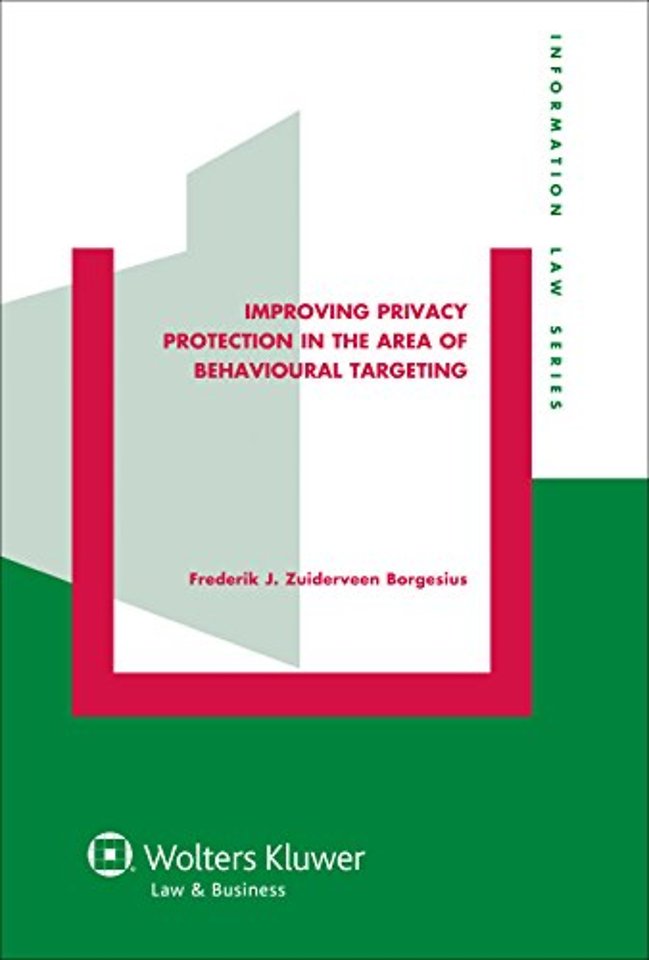
Improving privacy protection in the area of behavioural targeting
Gebonden Engels 2015 1e druk 9789041159908Samenvatting
Information Law Series Volume 33
This new book provides you with a highly readable overview of the policy
issues underlying behavioural targeting, and explains how the law could
improve on privacy protection.
The problem
At the core of many privacy problems on the Internet, behavioural targeting –
or online profiling – involves monitoring people’s online behaviour and using
the data obtained to expose people to individually targeted advertisements. In
the process, firms gather information, store it, analyse it, and disclose it
to other firms.
There is wide agreement that EU data protection law – and similar regimes in
countries worldwide – offers insufficient protection of privacy on the
internet.
The answer
This new work examines how the law could improve online privacy protection,
and is among the first legal studies to discuss the implications of
behavioural sciences for privacy law.
You’ll find a practical, in-depth study of how the law could improve
empowerment and protection of the individual, with a full discussion of the
challenges involved.
The author provides an overview of what data protection protects, and why. He
addresses whether data protection should apply to behavioural targeting, and
discusses the economics of behavioural targeting.
The work analyses the problematic role of informed consent in data protection
law, emphasizing the tension in the law between protecting and empowering the
individual.
Comprehensive coverage includes:
- the privacy implications of behavioural targeting
- the data protection rules that apply to behavioural targeting
- the scope of the personal data definition
- the role of informed consent in data protection law
- the policy implications of insights from behavioural studies
- the drawbacks of using informed consent as a privacy protection measure.
How will this book help you?
- Studies the ways in which privacy law could be improved – so that you have all
the knowledge you need to proceed
- Provides an in-depth description of how behavioural targeting works – so you
can evaluate the strengths and weaknesses of regulatory strategies to protect
privacy on the internet
- Analyses the role of informed consent in privacy and data protection law – all
the information you need
- Shows you how economics, behavioural sciences, and computer science can inform
regulation
Who should read this book?
This is one of the first books to discuss the implications of economic and
behavioural research for data protection policy. It will help practitioners,
business people, policymakers, and regulators to develop a more cogent,
socially responsible, and reasonable approach to privacy law and policy – not
only in Europe, but anywhere in the world.
Specificaties
Lezersrecensies
Inhoudsopgave
Anderen die dit boek kochten, kochten ook
-
 Mariette Lokin€ 93,95
 -
Arnoud Engelfriet€ 99,00
-
K. Lindenberg€ 62,50
-
B.F. Keulen€ 81,00
-
C.E. Huls€ 21,00
-
F.A.M. Schoenmaker€ 131,25




Rubrieken
- advisering
- algemeen management
- coaching en trainen
- communicatie en media
- economie
- financieel management
- inkoop en logistiek
- internet en social media
- it-management / ict
- juridisch
- leiderschap
- marketing
- mens en maatschappij
- non-profit
- ondernemen
- organisatiekunde
- personal finance
- personeelsmanagement
- persoonlijke effectiviteit
- projectmanagement
- psychologie
- reclame en verkoop
- strategisch management
- verandermanagement
- werk en loopbaan