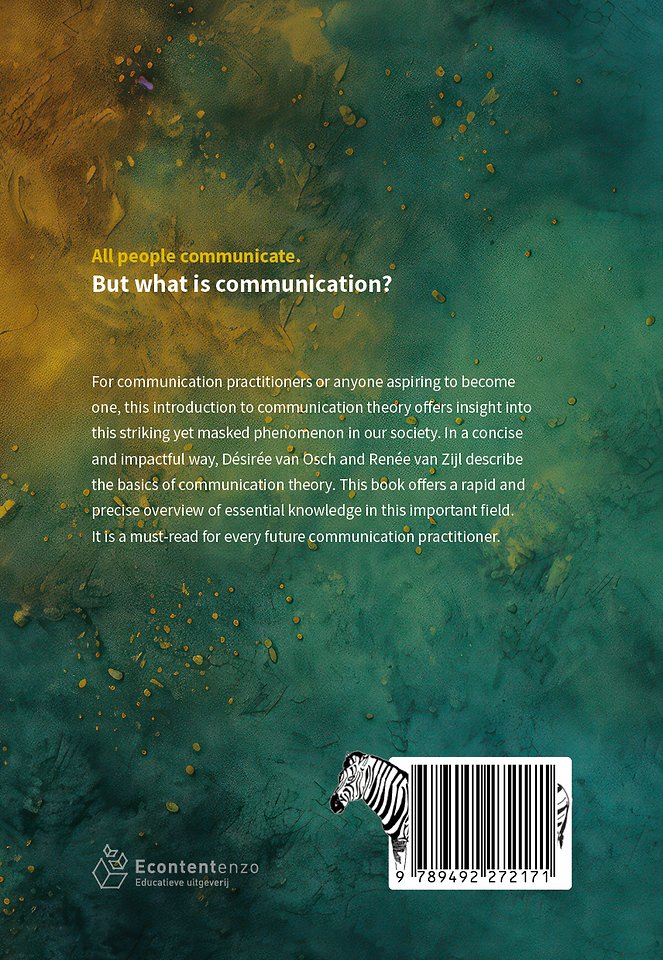

Communication Theory
An introduction for communication practitioners
E-book Pdf met watermerkbeveiliging Engels 2026 9789492272171Samenvatting
Communication is a widely used concept. Just notice how often it is used. It is also a broad concept and can be interpreted differently depending on the perspective. Many students develop professional communication skills as part of their studies. The 'how' of the communication profession provides so many possibilities that educational programs quickly become filled with a wide range of applied sciences.
However, what exactly does communication mean as a theoretical construct? To explore this topic, we must enter the field of communication theory, which is often underrepresented in communication educational programs and textbooks. Nevertheless, knowledge of communication theory forms the basis for making well-informed choices in the work of a communication practitioner. Especially at the boardroom level, a communication practitioner should be able to reason why one approach is more effective than another.
In their book 'Communication Theory,' Désirée van Osch and Renée van Zijl explain communication theory in an accessible and clear manner. They outline the basic concepts of communication, that are always somehow present when communicating. They explain the content of communication: information. After all, without information, there is no communication, whether it is consciously formulated or not. The authors provide an overview of common communication systems, including intrapersonal and interpersonal communication, group and mass communication, and communication through social media. They describe concepts, models, and processes of communication. The authors conclude the book with basic approaches for applying communication: the distinction between content and relationships, information processing, communication for behaviour change, and nonviolent communication.
This book is intended for students in applied sciences, such as communication, multimedia, and journalism. This book can also benefit communication practitioners who aim to enhance their understanding of communication and its underlying theories.
Specificaties
Lezersrecensies
Inhoudsopgave
1BUILDING BLOCKS
1.0Meaning-making
1.1Sender
1.2Receiver
1.3Signs
1.4Code
1.5Levels of meaning
1.6Encode and decode
1.7Intention
1.8Message
1.9Medium, channel, communication tool
1.10Noise
1.11Direction and influence
1.12Feedback
1.13Effects
1.14Success
1.15Information
1.16Communication
2INFORMATION
2.1Information carriers
2.2Information value
2.3Information transfer patterns
2.4Information selection mechanisms
2.5Nonverbal information
3COMMUNICATION SYSTEMS
3.1Place and time
3.2Intrapersonal communication
3.3Interpersonal communication
3.4Group communication
3.5Mass communication
3.6Mass self-communication
4TO COMMUNICATE
4.1Views on how to communicate
4.2Characteristics of how to communicate
4.3Models to communicate with
4.4Communication processes
4.5Ways to communicate
4.6Tools to communicate
4.7Effects of communicating
5ESSENTIALS OF COMMUNICATION
5.1The first decisions
5.2Information processing
5.3Influencing behaviour
5.4Semantic strategy
5.5Listening
REFERENCES
REGISTER
Anderen die dit kochten, kochten ook
-
 Joop Wolters€ 32,99
 -
Roderik Bender€ 25,00
-
Janneke van Heugten€ 34,99
-
Berthold Gunster€ 6,00
-
Martin van Kranenburg€ 27,50
-
Wil Michels€ 19,50





Rubrieken
- advisering
- algemeen management
- coaching en trainen
- communicatie en media
- economie
- financieel management
- inkoop en logistiek
- internet en social media
- it-management / ict
- juridisch
- leiderschap
- marketing
- mens en maatschappij
- non-profit
- ondernemen
- organisatiekunde
- personal finance
- personeelsmanagement
- persoonlijke effectiviteit
- projectmanagement
- psychologie
- reclame en verkoop
- strategisch management
- verandermanagement
- werk en loopbaan